AWS CloudFormation vs. Elastic Beanstalk: A Comprehensive Comparison

While both AWS CloudFormation and Elastic Beanstalk are powerful AWS services that help with application deployment and infrastructure management, they serve different purposes and cater to different needs. Let's dive deep into understanding these services and their key differences.
AWS CloudFormation: The Infrastructure Orchestrator
What is CloudFormation?
CloudFormation is AWS's Infrastructure as Code (IaC) service that allows you to model your entire infrastructure using code. Think of it as a blueprint for your AWS resources that can be version-controlled, replicated, and managed systematically.
Key Features of CloudFormation
Template-Based Infrastructure
Define infrastructure using JSON or YAML templates
Create, update, and delete resources in a coordinated manner
Version control your infrastructure definitions
Stack Management
Group related resources into stacks
Update entire environments atomically
Roll back changes automatically if errors occur
Wide Resource Support
Support for almost all AWS services
Custom resource types for specialized needs
Integration with third-party resources
Change Sets
Preview changes before implementation
Understand impact of infrastructure modifications
Reduce risk of unexpected changes
AWS Elastic Beanstalk: The Application Platform Manager
What is Elastic Beanstalk?
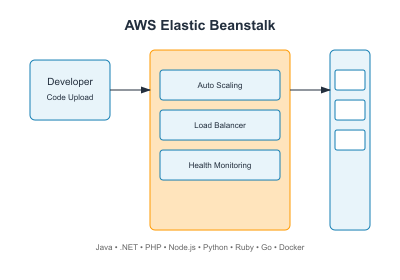
Elastic Beanstalk is a Platform as a Service (PaaS) offering that simplifies application deployment by handling infrastructure management, capacity provisioning, load balancing, and automatic scaling.
Key Features of Elastic Beanstalk
Simplified Deployment
Upload your code and Beanstalk handles deployment
Supports multiple programming languages and frameworks
Automatic platform updates
Environment Management
Managed platform updates
Health monitoring and metrics
Easy environment cloning
Auto Scaling
Built-in auto-scaling capabilities
Load balancing configuration
Capacity management
Developer Focus
Focus on application code rather than infrastructure
Built-in development tools
Easy integration with developer tools
Key Differences
1. Scope and Purpose
CloudFormation
Broader scope covering any AWS resource
More flexible but requires more AWS knowledge
Suitable for complex infrastructure needs
Elastic Beanstalk
Focused specifically on application deployment
More opinionated but easier to use
Best for standard web applications
2. Control Level
CloudFormation
Fine-grained control over every resource
Complete customization possible
Requires detailed AWS knowledge
Elastic Beanstalk
Higher-level abstraction
Less control but easier management
Handles many decisions automatically
3. Learning Curve
CloudFormation
Steeper learning curve
Requires understanding of AWS services
More time to become proficient
Elastic Beanstalk
Easier to learn and use
Focus on application rather than infrastructure
Quicker to get started
4. Use Cases
CloudFormation
Complex infrastructure setups
Multi-region deployments
Custom infrastructure requirements
Infrastructure standardization across organization
Elastic Beanstalk
Standard web applications
Quick application deployment
Development and test environments
Small to medium-sized applications
When to Use Which?
Choose CloudFormation When:
You need precise control over your infrastructure
Your infrastructure is complex with many interdependencies
You want to version control your infrastructure
You need to deploy resources beyond application hosting
You're building a large-scale enterprise application
Choose Elastic Beanstalk When:
You want to focus on application code rather than infrastructure
You're deploying standard web applications
You need quick deployment with minimal configuration
You don't require extensive customization
You're working with a small to medium-sized application
Can They Work Together?
Yes! Many organizations use both services:
Use Elastic Beanstalk for application deployment
Use CloudFormation for additional infrastructure needs
CloudFormation can even be used to create Elastic Beanstalk environments
Conclusion
Both CloudFormation and Elastic Beanstalk are valuable services with distinct purposes:
CloudFormation is your go-to for infrastructure management and complex deployments
Elastic Beanstalk is your choice for straightforward application deployment with managed infrastructure
The choice between them depends on your specific needs, team expertise, and application requirements. Understanding these differences helps you make the right choice for your use case.
About the author
I am a Software Developer from Italy.
Comments
Join the discussionNo comments yet. Be the first to comment.